


Set Mutations in Python Challenge on HackerRank
Set Mutations in Python is a challenge on HackerRank. The task teaches you how to change a set using update, intersection_update, difference_update, and symmetric_difference_update.
What Are Set Mutations in Python
A set stores unique values. Mutation methods change the set directly.
• update adds new items from another set
• intersection_update keeps only the common items
• difference_update removes matching items
• symmetric_difference_update keeps only the different items
These methods help you compare lists, filter values, and clean data in real projects.
Full Code for Set Mutations in Python
Below is the complete working solution used in the challenge.
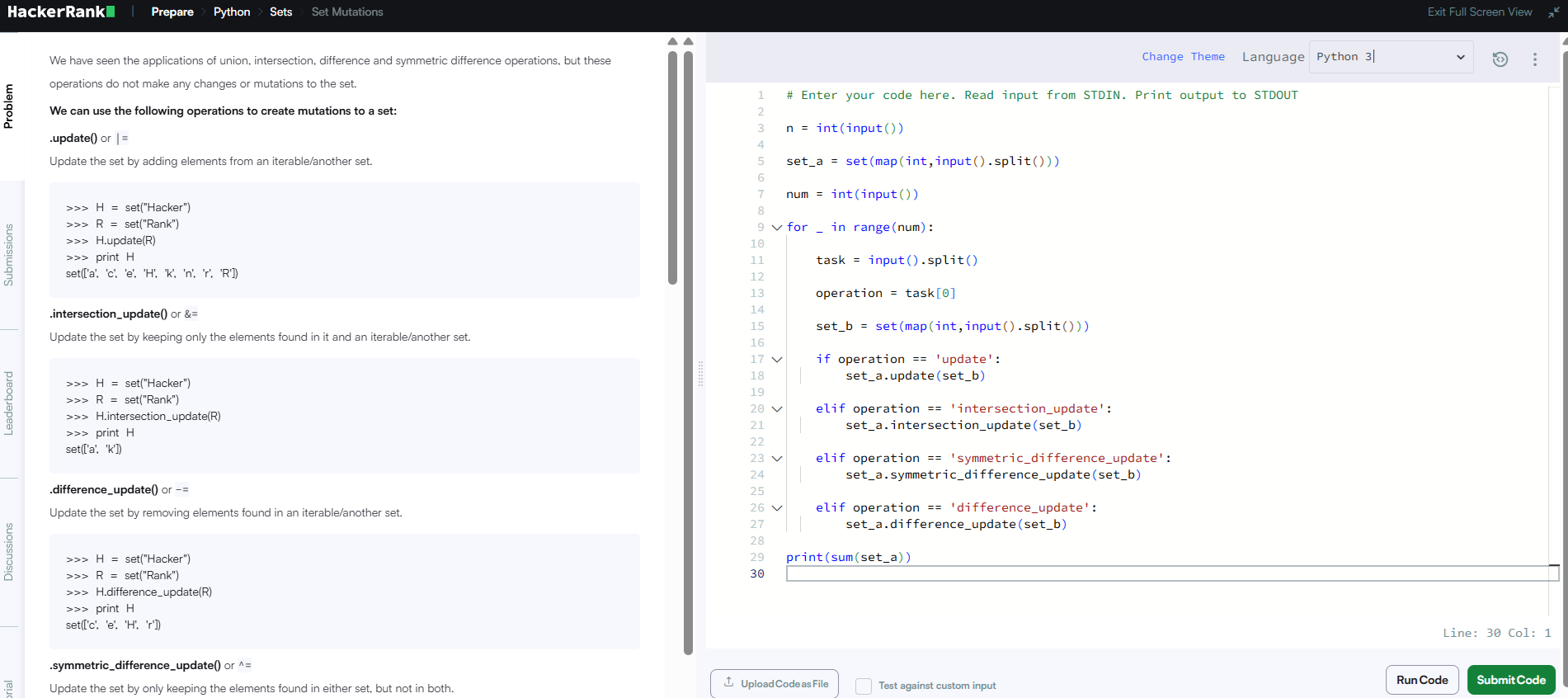
Line-by-Line Code Explanation
Step 1: Read the main set size
You read how many values the main set contains.
Step 2: Read and Create the Main Set in Set Mutations in Python
• Reads numbers in one line
• Converts them to integers
• Converts them to a set of unique values
Step 3: Read the number of operations
This tells how many mutation commands you will run.
Step 4: Start the loop
You repeat the next steps num times.
Step 5: Read the operation name
You read the command like update or difference_update.
Step 6: Read the other set
You read another set that will affect the main set.
Step 7: Apply the Correct Mutation in Set Mutations in Python
update adds items from other_set.
Example: {1,2} update {2,3} → {1,2,3}
Keeps only common values.
Example: {1,2,3} ∩ {2,3,4} → {2,3}
Keeps only different values.
Example: {1,2} ^ {2,3} → {1,3}
Removes matching values.
Example: {1,2,3} minus {2} → {1,3}
Step 8: Print the final result
Adds all numbers in the final set and prints the total.
Why Set Mutations in Python Are Useful
• Helps clean and compare data
• Good for filtering values
• Useful in coding tests
• Simple way to manage unique numbers
• Common in real-world Python tasks
Example
Main set: {10, 20, 30}
Other set: {20, 40}
Operation: difference_update
Resulting set: {10, 30}
Sum = 40
FAQs
What is the goal of this challenge
You apply several mutation operations and print the sum of the final set.
Does the order of operations matter
Yes, because every operation changes the main set.
Why is a set used instead of a list
A set removes duplicates and is faster for these operations.
Which mutation changes the set the most
update adds many values, symmetric_difference_update creates a new unique mix.
Do mutation operations create a new set
No, they modify the set in place.
Learn more about Python’s official documentation on Python.org.
Visit YouTube to View the Complete Solution
Check out my YouTube tutorial, where I run and walk through this exact code in real time, if you want a step-by-step video explanation.
Final Note
Set Mutations in Python gives you a solid understanding of how sets change when you use update, intersection_update, difference_update, and symmetric_difference_update. These operations help you compare values, remove unwanted items, and keep useful data in a clean way. Once you understand these mutations, you can handle many real data tasks with more confidence and solve coding problems faster.
Related Post:
Python Symmetric Difference HackerRank Challenge
Python set difference() Full Explanation with HackerRank Solution
Conclusion
Set Mutations in Python is an important topic for anyone learning Python. These operations help you manage unique values, compare data, and solve problems faster. You understand how update, intersection_update, difference_update, and symmetric_difference_update change a set in clear steps. This knowledge builds a strong base for data analysis and coding challenges.
Want to know what else you can learn with Python?
If you wish to grow in Python, data analysis, or data science, you can join our free workshop on Master’s in Data Science with Power BI. You learn how the field works and why skilled professionals earn strong salaries in this domain.
In this workshop, you understand tools and technologies from the beginning. This makes you ready for real data roles with confidence.
To join, register yourself on ConsoleFlare, and our team will call you.
Thinking, Why ConsoleFlare?
ConsoleFlare has been recognized as one of the Top 10 Most Promising Data Science Training Institutes of 2023.
You learn Data Science in simple Hindi, the way you speak daily.
Register yourself on ConsoleFlare, and we will call you back.