

In today’s world, everyone talks about data. Businesses collect it, store it, analyze it, and proudly say they are “data driven.” But here’s a truth many people quietly struggle with having data is not the same as knowing what to ask from it.
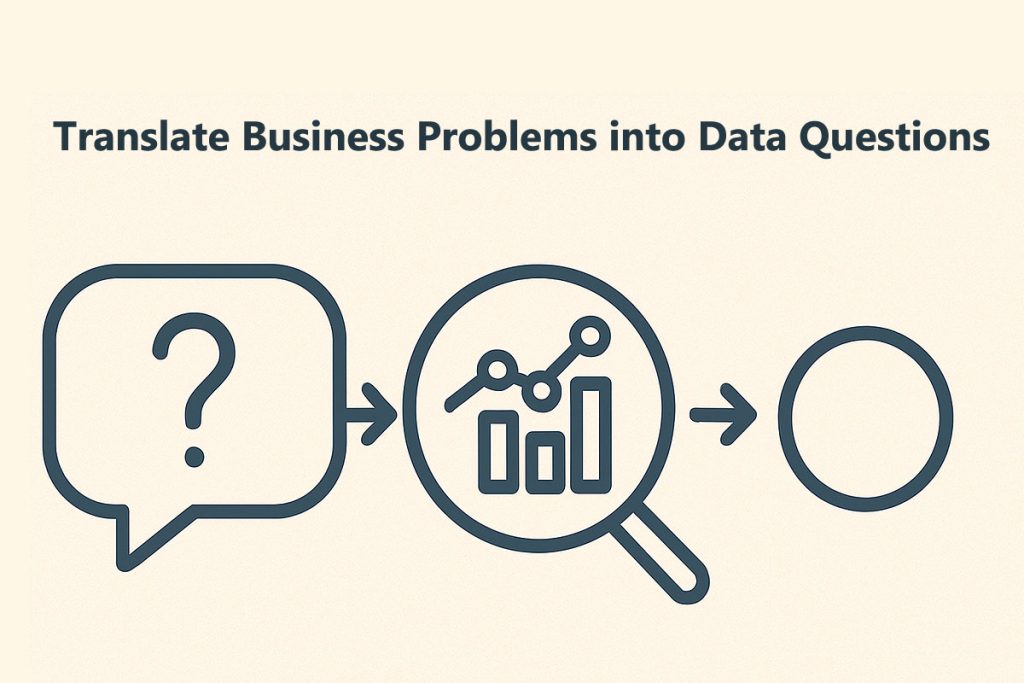
Most business problems don’t arrive neatly packaged as data questions. They come as vague concerns like “Sales are down,” “Customers are unhappy,” or “Marketing is not working.” The real skill lies in translating these business problems into clear, actionable data questions. This is where many projects succeed—or completely fail. Let’s break this down step by step in a simple, human way.

Why This Translation Matters So Much?
Imagine a doctor who orders random medical tests without understanding the patient’s complaint. Even with the best equipment, the diagnosis will be weak. The same applies to data.If you ask the wrong question:
- You get irrelevant insights
- You waste time and resources
- You make decisions that don’t actually solve the problem
- But if you ask the right data question, even basic analysis can create massive impact.
Simple Steps to Translate Business Problems into Data Questions
Step 1: Start With the Business Pain, Not the Data
One of the biggest mistakes people make is jumping straight into dashboards and spreadsheets. Instead, begin with a simple conversation:
- What exactly is going wrong? Who is affected?
- Since when has this been happening?
- Why does this problem matter to the business?
For example:
“Our revenue has dropped by 15% this quarter.”
This is not a data question. It’s a business problem. Your job is to understand it deeply before touching the data.
Step 2: Break the Problem into Smaller Pieces
Big problems are usually made up of smaller ones. Breaking them down makes it easier to analyze. Let’s take the revenue drop example. Revenue depends on:
- Number of customers
- Purchase frequency
- Average order value
Now the problem becomes clearer. Instead of asking:
“Why is revenue down?”
You can explore:
Are we losing customers? Are customers buying less frequently? Are they spending less per order? Each of these can become a focused data question.
Step 3: Turn “Why” Into “What” and “How Much”
Business stakeholders often ask “why,” but data answers “what,” “how many,” and “how often.”
For example:
Business question: Why are customers leaving? Data question: What percentage of customers stopped purchasing in the last 3 months compared to the previous period? This shift is critical. Data doesn’t explain emotions directly—it shows patterns and trends that help humans interpret the “why.”
Step 4: Define Clear Metrics and Terms
Misunderstanding terms can destroy analysis. Before framing data questions, clarify:
- What does “customer” mean?
- What counts as a “sale”?
- How is “active user” defined?
For example:
If marketing says, “conversion rate,” do they mean:
- Website visits to sign-ups?
- Sign-ups to purchases?
Ad clicks to orders? A good data question is precise, not open to interpretation.
Step 5: Frame Questions That Can Be Measured
A strong data question should:
- Be specific
- Be measurable
- Have a clear time frame
Weak question:
“Is our marketing good?”
Strong data question:
“Which marketing channel generated the highest return on investment in the last 6 months?”
Notice how the second one tells you:
- What to measure
- Over what period
- For what purpose
Step 6: Always Add Context
Data without context can be misleading. For example:
- “Sales dropped by 10%.”
- But compared to what?
- Last month?
- Same month last year?
Industry average? Better data question:
“How do this quarter’s sales compare to the same quarter last year, adjusted for seasonality?”
Context turns numbers into insights.
Step 7: Think About Decisions, Not Just Answers
A powerful data question is tied to a decision.
Ask yourself:
- What decision will be made after this analysis?
- What action will follow?
For example:
“Which products have declining demand and should be reconsidered or promoted more aggressively?”
This question doesn’t just inform—it guides action.
Step 8: Collaborate With Business Stakeholders
Translating business problems is not a solo task.
Talk to:
- Sales Teams
- Marketing Managers
- Operations Staff
- Customer Support
They understand the reality behind the numbers. Their input helps you ask better and more relevant questions.
Often, the best insights come from casual conversations, not meetings.
Step 9: Accept That the First Question Is Rarely Perfect
This is important: data questioning is iterative.
You might ask one question, analyze the data, and realize:
- The problem is different than expected
- Another angle needs exploration
- More data is required
This is normal. Effective analysts will continually develop and discuss their line of questioning.
Sample Business Situation
Business Challenge
“Users of our Food Delivery Application are Departing.”
Data-related questions from the above statement include:
- The Count of Users that became inactive Within the Last 30/60/90 days.
- Where are Users Dropping Off (During App Installation, Making Their First Order, or Leaving After Making Their First Order)?
- Is there a relationship between Delivery Time/Rating and Churn?
- Which cities have the highest user drop-off?
See how one vague problem turns into multiple actionable questions? That’s the skill.
Wrapping Up
In summary, the translation of business challenges into data-related inquiries is not dependent upon knowledge of SQL, Python, or the ability to interpret Dashboards. Rather, it requires clarity of thought, carefulness when listening, and an ability to ask questions that matter.
While data has the potential to be extremely valuable, its value can only be realized if it is being directed towards achieving an objective. If you develop the ability to translate business issues into Data Questions, you will have a considerably higher value than someone who understands only how to use data tools.
Because in the end:
Data answers questions—but humans must learn how to ask them well.
For more such content and regular updates, follow us on Facebook, Instagram, LinkedIn