


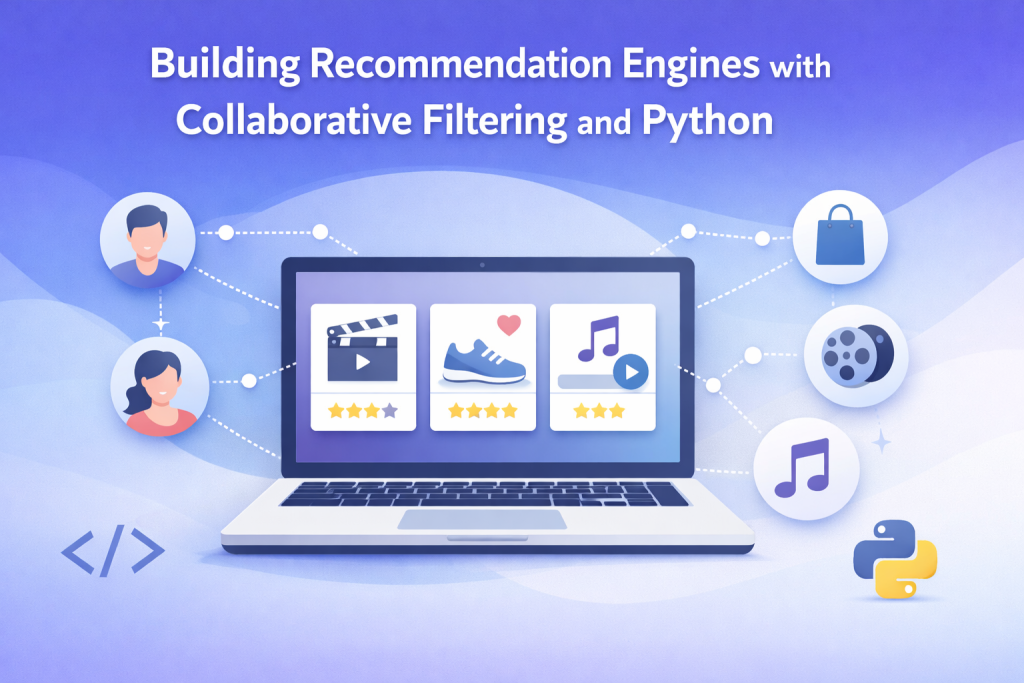
How beginners should start learning building recommendation engines is a common question. Many learners feel confused at the start. So, begin with simple ideas and clear logic. Focus on how recommendations work in daily apps. Avoid deep math in the beginning. Use small examples and real data. As a result, concepts become easy to understand, and learning feels less stressful.
What Are Recommendation Engines
Recommendation engines suggest items to users. For example, they suggest movies or products. So, users save time while choosing.
Also, these systems learn from past actions. They track likes, clicks, and ratings. As a result, suggestions feel personal.
Now, most digital platforms use recommendation engines. Because of this, learning them has value.
Understanding Collaborative Filtering
- Collaborative filtering uses user behavior. In simple terms, it compares people. So, similar users get similar suggestions.
- Also, item details do not matter here. The system only checks user actions.
- As a result, collaborative filtering works well with real data.
Why Collaborative Filtering Is Important
- Users face many choices online. So, recommendations guide them.
- Also, good suggestions build trust. Users stay longer on platforms.
- As a result, businesses see better sales and engagement.
Simple Real Life Example
- Think about movie apps. You and a friend like similar movies.
- Then your friend watches a new film. So, the app suggests it to you.
- This is collaborative filtering in action.
How Collaborative Filtering Works
First, the system collects user data. This includes ratings and likes.
Next, it checks which users behave alike. Similar behavior means shared taste.
Then, it predicts future choices. As a result, users get suggestions.
- First, collect user activity
- Next, find similar users
- Then, predict interests
- Finally, show suggestions
Types of Collaborative Filtering
- There are two main types. Both work in different cases.
- First is user-based filtering. It compares people with people.
- Second is item-based filtering. It compares items liked together.
- So, small platforms use user-based filtering. Large platforms prefer item-based.
Where You See These Systems Daily
- Online stores show related products. So, shopping becomes easy.
- Video apps suggest new shows. Music apps suggest new songs.
- As a result, users discover content faster.
Why Python Is Used for Recommendation Engines
- Python is easy to read. So, beginners learn it fast.
- Also, Python has strong data tools. These tools save effort.
- As a result, Python suits recommendation engines well.
Common Python Tools Used
- Pandas manages user data. It works like a table.
- NumPy handles numbers. So, math becomes simple.
- Scikit learn supports basic models. Therefore, learning stays easy.
Data Needed for Collaborative Filtering
- You need user and item data. Ratings work best.
- Each row links a user with an item.
- So, the system learns patterns from this data.
Basic Python Flow
- First, load the data into Python.
- Next, create a user item table.
- Then, calculate similarity scores.
- After that, predict missing ratings.
- Finally, show top recommendations.
- Load data
- Create matrix
- Find similarity
- Generate results
Challenges You Should Know
- New users have no data. This is a cold start problem.
- Also, new items face the same issue.
- Large data needs more power. So, systems need planning.
How Beginners Should Start Learning Building Recommendation Engines
- Start with simple logic. Avoid complex math early.
- Then, use small datasets. Practice often.
- As a result, confidence grows step by step.
Why Practice Matters in Building Recommendation Engines
- Reading alone is not enough.
- So, build small projects.
- For example, suggest movies to friends.
- As a result, learning feels real.
Learning Support Makes Building Recommendation Engines Easier
- Good guidance saves time.
- Also, simple language improves clarity.
- Trainers with experience share real insights.
Where You Can Learn Building Recommendation Engines Effectively
- Platforms like consoleflare.com focus on clear basics.
- They teach in Hindi and English. So, learning feels easy.
- The courses stay affordable. As a result, returns stay high.
- You gain practical, job-ready skills.
Related Post:
A/B Testing Strategies for Data-Driven Product Decisions
Resume for Data Analytics: Tips to Write a Standout Resume
Conclusion:
Building recommendation engines is possible for beginners. You can start with simple ideas. Collaborative filtering helps you learn real logic. Python makes the process easy to follow. So, practice often with small data. As a result, you gain skills that work in real jobs.
Follow us on Facebook, Instagram, and LinkedIn for more useful advice, real-world examples, and career counseling.